

What Happened To My Video Games?!
I knew I’d be able to shoehorn video game topics into my blogs at some point, and this seems pretty relevant. You see, back in the good old days of video games you went to a shop near where you lived and looked at the back of the boxes, read the blurb and looked at the blurry screenshots. You had to decide whether it was worth your time based on a very small bit of information. Sure, there were magazines to buy with reviews in but oftentimes the games would already be on the shelves. You bought a game, crossed your fingers and hoped it was good, took it home and played it. Thing is, when you bought the game, you got the whole game, not part of a game. On the cartridge was a complete game from start to finish, you didn’t encounter a platforming section with a sign that said “platform(s) to reach the next stage due in Q4 2026.”
But as video games grew as a business (today, the video games industry is roughly worth $197 billion) so did the demands of the release schedule, gone were the days of “we’ll release it when it’s ready.” Crunch became commonplace as timescales were constrained to a publishers schedule. Enter the era of the First Day DLC. This now meant a publisher didn’t have to ship a fully finished game, they could let the game go to master, release it on time all the while the developers could continue working on the game and release a day one patch.
Then we have Live Service Games with their business model of microtransactions, subscription fees, and season passes. This means constantly engaging with “consumers” with new features, new updates, new “character uniforms” or some form of in-game merchandise. Anything to keep the game fresh, relevant, and in the minds of players. Once your game drops out of view and people forget, it becomes irrelevant and the plug gets pulled.
Live Service Games sounds very familiar…
Constant Changes
I wrote about my own attention span and focus issues over a 3 part series (part 1 here) in which I had trouble concentrating on learning, reading, and getting tasks done. It was the attention redirection that was the problem, I was doing activities that were causing my dopamine to spike and crash which meant I had trouble concentrating on meaningful activities, part of that was scrolling social media and short-form content. When you scroll, you’re inundating your brain with a series of fast moving “bits” of information. Your brain is having to deal with and try and process this constant change of information.
And it’s this constant change, constant velocity, constantly moving ahead that’s happening in software. We know vendors no longer ship software in a finished and complete state, if you were a vendor why would you when you can iterate and constantly release a stream of new features and bug fixes? I’ve lost count the number of times people have posted in forums about certain data platform features that “should have been there from day one” and yeah, I hear you. I want to be able to press the jump button and land onto the next platform and progress to the next stage now.
What I would like to highlight is that I’m not complaining about change, but I want to highlight what possible effect it may have on our attention spans and focus.
If we use cloud platforms we have to accept living in a world of constant change and dare I say it “agile architecture.” Are you trying to design a stable data architecture for 1, 2, 3 years time using a cloud platform? You will need to keep up-to-date with the changes, you have no choice. You have to pay close attention because if you choose a cloud platform you need to know when certain features that you need get added in.
In theory, sure. In practice, anyone who has worked in a real organisation knows that modifying or even changing an established data platform isn’t something you do on a whim. It involves budgets, security reviews, vendor contracts, organisational trust, and a lot of justification to people whose job it is to reduce risk and not just chase novelty. And that’s not even factoring in understanding it all from a technical and delivery viewpoint.
Squirrel!
If you as a vendor are releasing new features on an ever-increasing schedule, are you simply trying to keep people’s rapidly destroyed attention spans focused on your platform to keep your product in people’s minds and therefore relevant? Why not batch the feature changes up and release quarterly? Do we really need feature changes on a weekly and oftentimes daily cadence? More and more frequent updates just mean we need to maintain our focus on these constant changes. I feel for the product managers, their headspace constantly filled with what’s upcoming, what’s needed, what will be next? How will people respond? They have a hard job, I do salute you.
In The Second Screen problem in a Dopamine talk I have started to recently deliver, I talked about the concept of dumbing down of film and TV content because people are not concentrating on one screen and one set of content at once, often “scrolling” on a device getting dopamine hits whilst (attempting) to watch a film or tv series. Perhaps this is happening with data platforms but in a different way, do we get dopamine hits from new features? If so then the constant stream of changes and new features is just like endless social media scrolling, perhaps you’ve just gotten used to the dopamine hit of a new feature? The problem here is that what goes up must come down and when dopamine goes down…there’s a problem.
Am I just tired of the constant changes and new features or is it linked to my recent dopamine adventures and enlightenment? I’ll be honest I did get a buzz from a new feature that I could jump on…but usually couldn’t ever do anything commercial or “useful” with it. Maybe I was just getting a dopamine hit..which then meant I crashed afterwards and waited for the next new feature.
The Changing Of The Game
The phrase “game-changer” crops up with more worrying frequency, you’ve seen the posts by vendors and advocates shouting about the new latest features and services with the promise of “it’s a game-changer!”
IMHO anyone putting that in their blogs or social media posts needs to realise most folk really don’t want the game changed, they want the game consistent and predictable so that they can plan and develop accordingly without the rug being constantly pulled and having to explain to those around them how and “why” it’s changed. “We’ve had to change our data architecture again because this service now has a game changing feature we needed to use and we’re really happy with that” said no one, ever. I’m not saying progress shouldn’t be made, but more thought needs to be given when planning service and feature changes I believe.
I’ve been working with Azure services on a recent project, these services are mature. It’s predictable and the headspace I’ve reclaimed by just using services I know won’t change or release another “game changer” service or feature is enormous. The clarity of thought I have on this project is mind blowing. And that’s because my attention span hasn’t been ruined by the changing of the game.
The issue here of course is people like me (yes me…) posting about the new stuff all the time. Quick! Over here! Look at this new thing! Don’t worry about that “old” thing I was shouting about recently, that was soooo last week! Just throwing new stuff out there without any empathy or thought to how people who are simply trying to get their work done would feel…”really? Do I now need to know this new stuff?” Probably not.
I’ve been using a term the last few months Process Over Platform as I try and diversify and not put all my eggs into one basket…but it’s difficult because how can you diversify your tech stack AND keep up to date with what’s going on across all those tech stacks? It’s all you would do with your time.
Stats Stats Stats
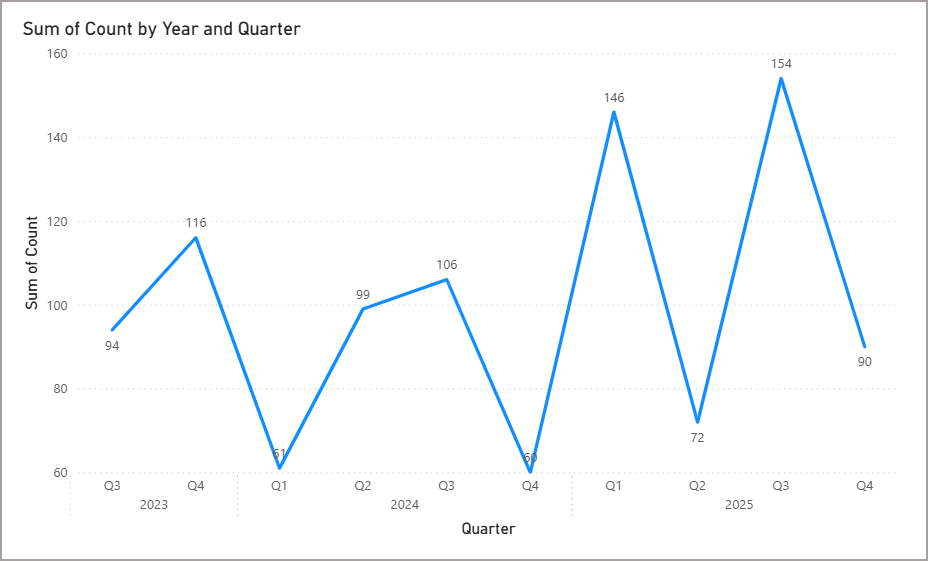
Let’s get to some numbers and badly created graphs (look, I’m not a data visualisation expert ok) to show the trend of new features and sheer amount of information. In no particular order we have the number of blogs published on the Official Microsoft Fabric blog since early 2023. As we can see, the number of posts has grown considerably over the last nearly-3 years, perhaps that’s to be expected as the platform grows and as new features and services are added. That’s still a huge amount of growth and if you expect to keep up with everything then you’d better get reading (more on that later).
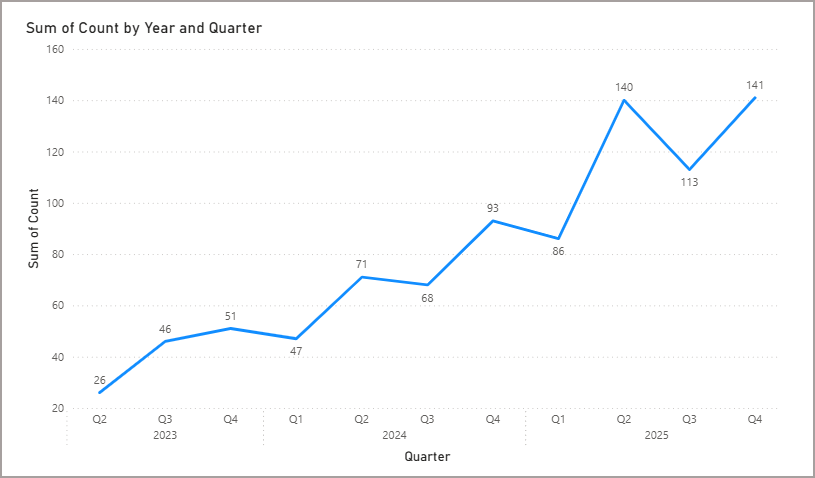
What about the Fabric platform updates themselves? After all, several blogs could be published on 1 new feature alone. As we can see, not a huge increase month-over-month but we still see growth in the number of individual platform updates describes in the monthly update blog (this is with Power BI specific updates removed from the chart, it’s just Fabric items). The dips are mostly end of year (hey, those MS folks need some time to unwind too) and the spikes are big conferences like Ignite and FabCon where big batches of platform updates are released.
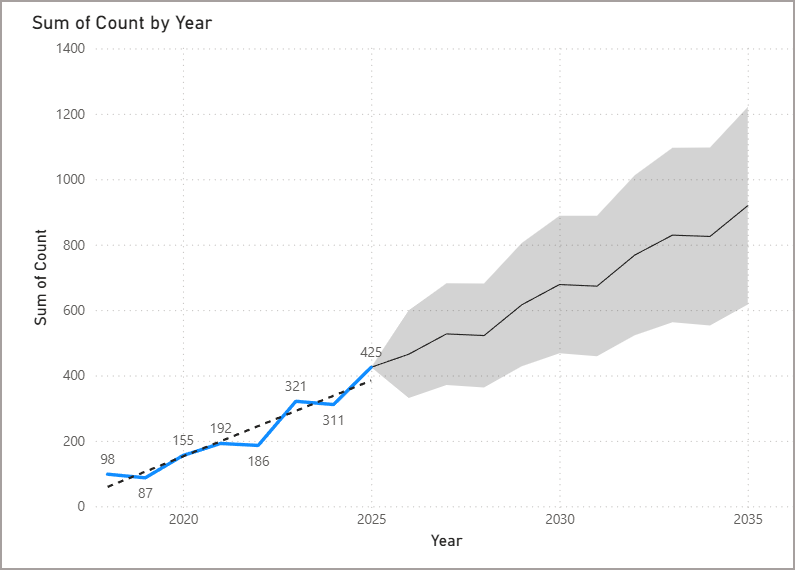
What about Databricks? Well, quite busy as you can see. This is taken from the Databricks platform release notes on Azure Databricks and the growth year-over-year is staggering. I’ve had a bit of fun and projected forward the number of updates you’ll need to contend with in 2035…nearly 1,000. Hey, I’m just mucking about, but you can see how many platform release updates there are in 2025 vs 2020… Of course some of those updates will just be “such-and-such is now in GA” but still, there’s a lot for your brain to digest.
Keeping Up To Date
So what do we do about this? How do you stay informed without destroying your attention span in the process? The boring answer is discipline and accepting that discipline looks different for everyone. Not everyone needs to read every release note, blog post, YouTube deep dive, and hot take thread. In fact, trying to do so is probably the fastest route to feeling overwhelmed and permanently behind.
The surface area is enormous now. Skool communities, Reddit threads, YouTube channels, vendor blogs, conference announcements. It’s simply not realistic to cover it all. The pragmatic approach is to consciously reduce that surface area. Pick a small handful of sources you trust and ignore the rest.
There are also people doing genuinely excellent work curating and summarising changes, pulling out what actually matters and not just amplifying noise. Lean on them. You don’t need first‑hand exposure to everything to be informed.
One mental model that has helped me is ruthless triage. Am I actively working with this service or feature right now? If yes, it’s worth reading. If not, will I realistically be working with it in the near future? If yes, it goes on a backlog. If the answer is no, it gets parked firmly in a “future curiosity” bucket or I just ignore entirely.
The hardest part is accepting that you cannot know everything, and that being selective is a survival skill and not a professional or personal weakness.
What Now?
The most important thing in all of this is to look after yourself. Not in a vague, hand‑wavy way, but in a very practical way. The constant pressure to keep up, stay current, and remain relevant has a real cognitive cost and attention issues are often a symptom of that pressure rather than a personal failing. When everything is framed as urgent and/or game‑changing it’s no surprise people feel overwhelmed. That sense of “I should be reading more, learning more, keeping up better” is mentally exhausting, and makes it harder to focus on the things that actually matter.
A lot of attention problems can come from trying to hold onto and focus on too much context at once. Try narrowing your scope and being selective about what you engage with, and just accept that “not keeping up with everything” is actually a way of protecting your headspace. With that headspace comes better focus, clearer thinking, and frankly, more enjoyment in the work itself.
The industry will continue to move quickly. Features will continue to ship. Announcements and people will continue to shout for your attention. You don’t have to respond to all of it. Choosing not to is often the most sensible decision you can make.
Look after yourself please.
And yes, the Super Nintendo is my favourite console of all time.
References
- Dopamine – andy.cutler
- Dopamine Part 2 – andy.cutler
- Dopamine Part 3 – andy.cutler
- Microsoft Fabric Blog
- Azure Databricks platform release notes – Azure Databricks | Microsoft Learn
- Live service game – Wikipedia
 Andy
Andy