

Trigger warning: This blog post contains a small mention of general mental health conditions, but is as the title suggests mostly focused on attention span and a chemical/hormone called dopamine.
It Is Technical
Where were we? Oh yes, I couldn’t learn, read, or complete tasks without a huge amount of effort. My concentration, attention span, and focus were all out of whack. Jeez that sounds bad… If you haven’t yet, have a read through part 1 where I talk about the dull throbbing sensation in my head. Again you might ask “but what has this got to do with anything technical?” well I’ll tell you, it has everything to do with everything technical. If you can’t concentrate on doing technical things and it’s your career, you’ve got a challenge that needs to be addressed. Simple as that. Look, we’ll get to the dopamine bit soon I promise but let’s get into how I got there.
Troubleshooting
Troubleshooting, that sounds so technical…so…clinical. But how to find the problem? Well, I looked at some major areas: Tiredness and Sleep, Mental Health issues, Burnout… could it be one or more of these?
Tiredness. Sleep issues are everywhere and from the small amount of research I’ve done on the subject it looks like millions of people across the UK have issues with getting good quality sleep with “The average UK adult only gets three days a week of good quality sleep.” being a big issue. I definitely don’t get the recommended 8 hours (well, 7-9 hours is actually recommended), but I’m not far off as I’d say I average about 6-7 hours a night. Yes there are nights that are less hours due to circumstances, late nights working and all that, but generally I feel mostly refreshed in the morning. But here’s the thing, I get more sleep now than I did 6-10 years ago as my kids are older now and have less nightly disruptions, and I know 6-10 years ago I didn’t have much trouble with learning, getting certifications done, and reading. I didn’t entirely write-off sleep as not being the problem but I figured it wasn’t the main driver of my focus.
Mental Health. Again I did a small amount of research and found that 1 in 5 adults in the UK have some form of mental health condition, and that’s a lot. So I took a variety on online tests and made sure I answered the questions honestly. They all came back not indicating depression or anxiety. I kinda knew they would as a lot of tests are based around “feeling hopeful” and “being able to face the day” which is no problem for me. I know these are generic indicators and of course if you feel like you’re struggling with mental health you should seek out professional advice. I’m woefully unequipped here to offer any other advice beyond that, for that I’m sorry…but I’d rather be honest here.
Burnout. I could have categorised this as mental health but I want to discuss it separately, from what I read about burnout it’s not classified as a “mental health condition” but rather a “syndrome.” But I’ll need to leave that to the professionals to talk about where it lives. Burnout is described as “a state of severe physical, emotional, and mental exhaustion caused by prolonged, unmanaged chronic stress, often stemming from the workplace” and, well look, I’ll skip straight to the point here and say that no I wasn’t suffering from burnout. Being a little tired, unfocused, and not able to complete some things in my life I want to do is not a signifier that I have burnout. Burnout is serious and I would never want to treat it trivially and say that’s what the problem was. I’ve known people with burnout and it’s not good.
Not Being Honest
I said I’d be honest, right? In part 1 I talked about my “mind wandering” when trying to learn, read, work through tasks. In fact the way that my mind wandered was actually manifested in doing something else…and that something else was picking up my phone. There I said it. Wait, wait! Before you close this browser tab and think “yeah the guy just needs to put his phone away then he’d get stuff done! Simple, it’s not rocket science!” let me try and explain what was going on.
I then listed all activities, what exactly was I doing and when was I doing them? OK stop laughing at the back… *cough* be serious now. This is the crux of it, when I was trying to do something it wasn’t as if I was sat there doing nothing, I was clearly doing something. And it was that something that was distracting me.
Here’s what a typical day looked like:
Wake up, reach for phone while still in bed and quickly scroll Emails, Teams, & LinkedIn. Get out of bed, walk dog, feed dog, sort kids for school, phone is in back pocket the whole time for this and I regularly look at it. Take kids to school, sit in car for 5 minutes on phone before heading home. Shower, dress, phone goes in back pocket. Make breakfast, watch YouTube on phone, scroll Bluesky, Instagram, probably LinkedIn again. Rinse and repeat throughout the day, there’s not an activity that doesn’t involve the phone being used at some point. And yes, that includes going to the toilet… But the thing here is that I could be on YouTube for 15, 20 minutes, and then the same amount of time scrolling through Instagram.
But it can’t all have been malnourished social media? Well no, I was also on Reddit scrolling subreddits about Data Engineering, Fabric, Databricks, opensource etc. Then heading over to various official community forums. Each time posting comments and answering questions. And of course my brain wanted me to go check in every so often so see what was new.
So I was doing stuff, I did have an attention span and focus but it was being used on the wrong things, not on the activities and tasks that actually brought any meaning or growth to my life and work. I did struggle then to try and find how to go about searching for this problem…searching for “I’m concentrating on the wrong things” and “I have an attention span but it’s being used on the wrong things” didn’t help much. I ended up down a rabbit hole of people talking about ignoring past mistakes! Not quite what I was looking for and I stumbled from article to article and got much the same content, lots of talking about discipline, of “putting the phone down will help your attention span” but nothing of any substance or any root cause. Then I stumbled across an article talking about attention spans being affected by social media, one of many…but this time there was the word that I’d been unwittingly searching for and jumped out at me…dopamine.
Dopamine
Well done, if you’ve kept reading then we’ve finally got to the meat of the subject…Dopamine. Thanks for sticking with me. This is where I get a little generic about what dopamine is before I weave it back in to how it relates to me. Now, that article states “When dopamine is released in the brain, it makes us feel happier. This is why we constantly wait for the next notification on our phones, making us more vulnerable to distraction.” And this is exactly why I kept picking up the phone, maybe not directly because of the notifications but because I knew there was new stuff waiting for me, I didn’t need a notification to tell me that. I knew about “dopamine hits” but really hadn’t realised that’s what social media and short form content is doing…it’s hijacking the dopamine. Let’s get into some science that I looked up online about and started reading…and then I’ll tell you as if I’m some kind of pseudo-expert. This isn’t a blog to get right into the mechanics of dopamine, so I’ll just tell you it gets made in the hypothalamus in the brain. Right, that’s sorted that then and I completely sound like I know what I’m talking about 😉
Back in the days before Deliveroo and Just Eat, we had to go hunting and scavenging for food and water. We had to make fires and shelters, protect and care for our families, and try to just survive. The brain and body had to try and motivate us to do these things as they were hard, if we weren’t bothered at all we’d have starved and that would be the end of it. There was a study with a genetically modified mouse that had no dopamine, even when food was put near it just didn’t bother…it wasn’t motivated to go get the food even when it was in paws reach. Poor mouse. The problem is over the years life has evolved, we don’t need to go out and face off against a sabre-toothed tiger, but we might have to face off on a shopping trolley with a wonky wheel or a delivery driver that can’t seem to find you despite you being right there.
So where does our dopamine come from now? It should come from completing activities and tasks that enrich our lives and our work. But apparently our brains just love to go off-piste and search out faster, easier ways of getting a dopamine hit. As it turns out, there are a couple of main ways that dopamine gets released. And no, my dopamine wasn’t coming from the “good” way.
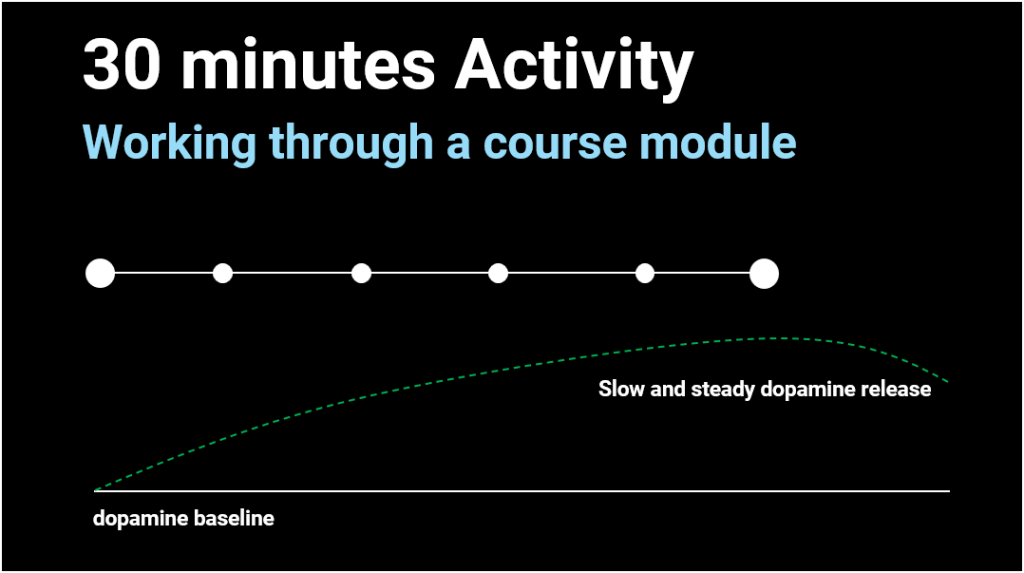
Here’s my ham-fisted effort in trying to convey what’s happening with the release of dopamine in your system. Here we have 2 activities I’ve been doing, I’ll let you guess which is the activity that will enrich my life, and which one is a waste of time… The first activity is working through a course module, it has a series of tasks like an introductory video, a couple of topic videos, a quiz, and then a hands-on lab. Sure, there are different tasks but they follow the same theme and lead on from one another. This type of activity, should I manage to consistently engage with it, will slowly release dopamine into my system. I’ll get pleasure from completing it, I’ll get rewarded for completing it. The problem here is that it’s a harder activity to start and get into, harder to get into a flow state. I’d love to discuss flow state in more detail but…time. Suffice to say it’s when you get into a hyper-focused state on the activity you’re doing and possible distractions simply melt away.
The good thing about a slower release dopamine activity is you don’t get jolted highs of a spike, and you also don’t get a crash. Your dopamine levels will drop back down to a balanced level (homeostasis) and that’s a good thing, we want that.
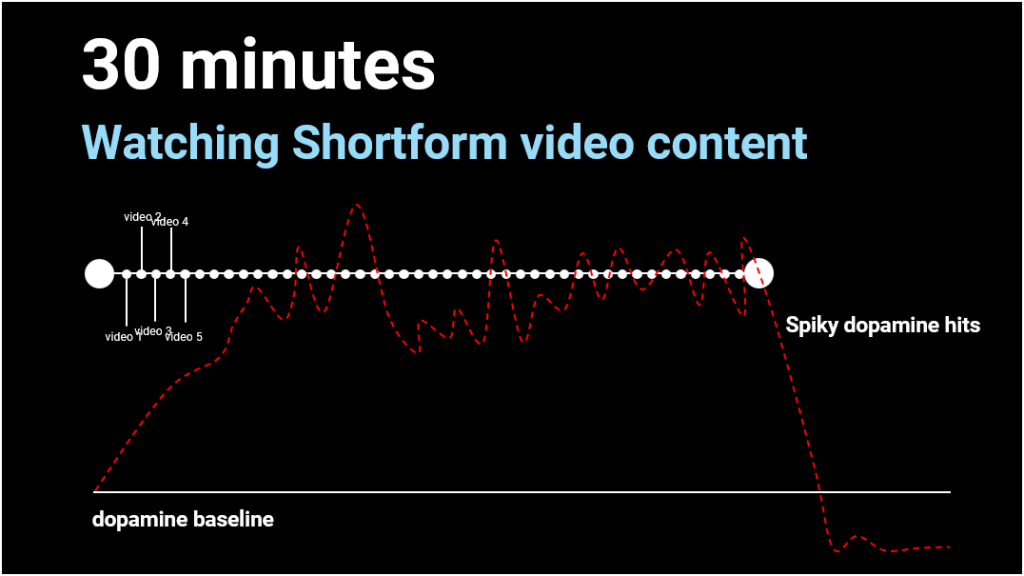
Compare that to the dopamine hits of 30 minutes browsing social media and short form video content. The dopamine rise is much higher much quicker and remains high throughout the activity. The activity itself is scrolling through post after post, video after video. Your brain rewarding you for each and every interaction. At some point what goes up must come down and because of such extreme highs, we end up with a dopamine deficit. This isn’t good, because in a dopamine deficit our mood becomes low, we become demotivated. And not to mention the fact that the brain has to process each and every post and video you see, they’re all discrete bits of content and although you might take a cursory glance, your brain is busy trying to process it all.
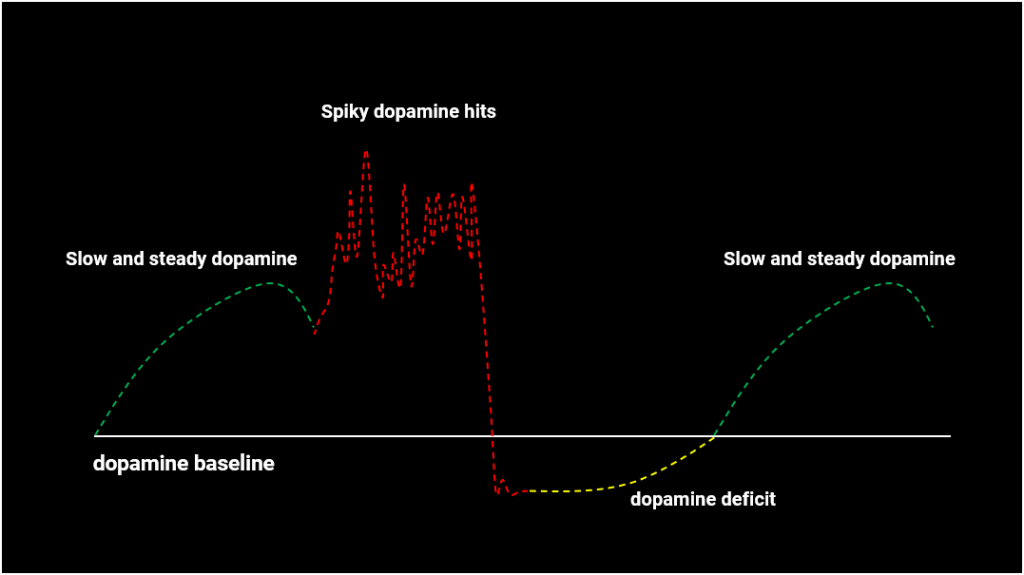
But those 2 activities are rarely separated, one may lead into another. Now let’s put these activities together, let’s say the first activity is writing a piece of code, after I finish I’m feeling pretty good! That’s my system rewarding me with a nice slow dopamine release. Feeling good I decide to reward myself with a scroll through social media…big mistake because now I get a dopamine hit, it boosts up only to come crashing down with a deficit. Now I’ve got to try and get myself motivated again, back to a baseline before I can even begin the next task. It’s hard enough as it is to get going on a task and get that slow dopamine release, now I’ve just interrupted all that good work from earlier. And for what? The digital equivalent of junk food. no nutrition whatsoever.
Yes, social media is the digital equivalent of junk food. During my reading of the impact of social media usage on the brain, attention span, and motivation, it’s been commonly categorised as having the same impact on the dopamine system as junk/sugary foods, alcohol & drugs, porn, gambling, online shopping addiction. Whoa…OK, this is pretty serious stuff now.
The Fix
So the fix is clear then, right? I just put down the phone, or tablet, or close those browser tabs and all good? The problem is not just putting down the device, it’s stopping picking it up in the first place. The phone does everything! Banking (including personal and business), security with multi-factor authentication, payment processing, camera for photos and videos. It’s pretty much saying “put down that device that basically runs a whole bunch of stuff in your life.”
There’s also another problem, there is a lot of self-help out there, books, podcasts, courses, all telling you they can “cure” you and get you back to being an efficient and productive person. It’s the ultimate grift (well, that and how to make money…) and how on earth do you choose? Well, the resources that I’ve been reading up on about dopamine also include how I can redirect it back to the activities and tasks that actually enrich my life and work. This is what we’ll cover in part 3, the final part.
Reach out to talk to me about any of this stuff, I’m over here Andy Cutler | LinkedIn
References
- Average adult has only 3 days a week with good quality sleep | Mental Health Foundation
- https://mentalhealth-uk.org/burnout
- The DOSE Effect: Unlock the secret powers of dopamine, serotonin and more in this new self-help guide to feeling healthier and happier from a Sunday Times bestselling neuroscientist eBook : Power, Tj: Amazon.co.uk: Books
- Dopamine: What It Is, Function & Symptoms
- Social media causes attention spans to drop – The Standard
- Dopamine Deficient Mouse – an overview | ScienceDirect Topics
 Andy
Andy